

Imagine a world where soldiers on the battlefield can create essential tools and equipment on demand, with the simple push of a button. This is now becoming a reality thanks to the remarkable advancements in 3D printing technology. In this article, we will explore the various applications of 3D printing in the military, from the creation of customized gear and spare parts to the potential for building entire structures in remote locations. We will also delve into the challenges that come with implementing this groundbreaking technology within the military, and how it is revolutionizing the way armed forces operate. Get ready to be amazed by the boundless possibilities that 3D printing brings to the battlefield.
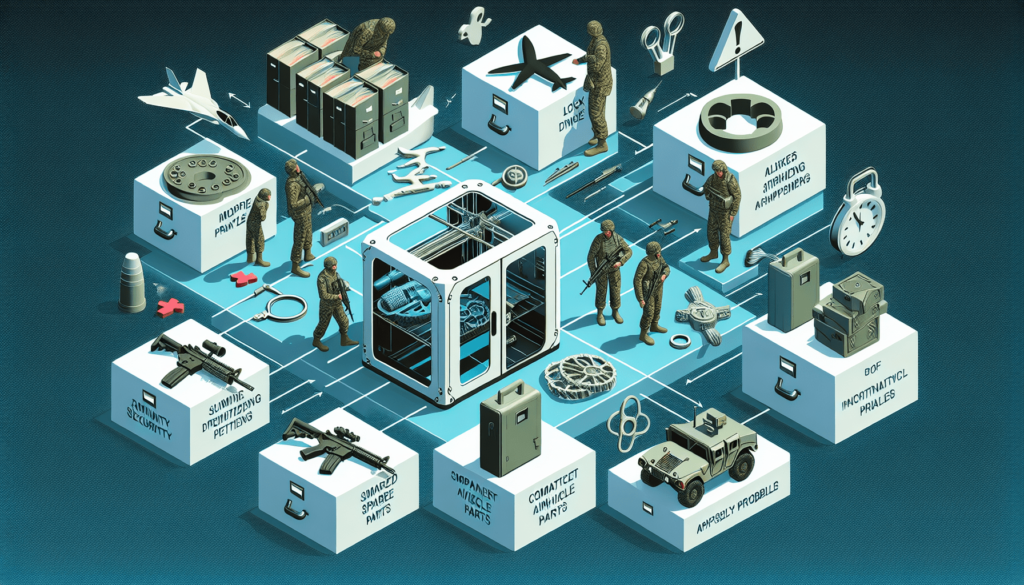
Applications of 3D Printing in the Military
Prototyping and rapid production
3D printing has revolutionized the prototyping and rapid production process within the military. Instead of relying on traditional manufacturing methods that can be time-consuming and costly, 3D printing allows for the quick and efficient production of prototypes. This is particularly valuable in the military, where the need for rapid iteration and innovation is crucial. With 3D printing, military personnel can design and create prototypes in-house, reducing the time and resources required to test new concepts and ideas.
Customization and personalization
One of the key advantages of 3D printing in the military is the ability to customize and personalize equipment and tools. In a military context, where individual soldiers have different needs and requirements, this level of customization can be crucial. 3D printing allows for the production of personalized equipment, such as helmets or body armor, tailored to the specific requirements and measurements of each soldier. This not only enhances comfort and functionality but also improves overall operational effectiveness.
Supply chain management
The military relies on a complex network of suppliers and manufacturers to fulfill its equipment needs. However, this traditional supply chain is often slow and vulnerable to disruption. 3D printing offers the potential to revolutionize supply chain management in the military. By enabling on-site manufacturing capabilities, the military can reduce dependence on external suppliers and streamline the logistics of equipment procurement. This can improve operational readiness and reduce the risk of supply chain disruptions.
Reducing costs and logistical challenges
3D printing has the potential to significantly reduce costs and logistical challenges in the military. Traditional manufacturing processes often have high production costs, especially for low-volume or specialized items. By utilizing 3D printing, the military can reduce production costs, as well as eliminate the need for expensive tooling and molds. Additionally, 3D printing can reduce logistical challenges by enabling on-demand manufacturing, eliminating the need for large-scale inventory management and long lead times.
Advantages of 3D Printing in the Military
On-demand manufacturing
One of the most significant advantages of 3D printing in the military is on-demand manufacturing. With traditional manufacturing processes, lead times can be lengthy, leading to delays in equipment delivery and operational readiness. 3D printing enables the military to manufacture equipment and spare parts on-site, eliminating the need for extensive inventory management and reducing wait times. This ensures that the military can quickly respond to changing operational requirements and maintain a high level of readiness.
Enhanced operational readiness
Operational readiness is essential in the military, and 3D printing can greatly enhance this aspect. By reducing dependence on external suppliers and enabling on-site manufacturing, the military can ensure that equipment and spare parts are readily available. This reduces downtime and increases the overall operational readiness of military units. Additionally, 3D printing allows for faster iteration and innovation, enabling the military to respond quickly to emerging threats and adapt to changing battlefield conditions.
Reduced wait times and downtime
Traditional supply chains often result in lengthy wait times for equipment and spare parts. This can lead to significant downtime and operational inefficiencies. 3D printing offers a solution to this challenge by enabling the production of equipment and spare parts on-demand. With 3D printing, military units can quickly produce the required items, reducing wait times and minimizing downtime. This improves operational efficiency and ensures that military personnel have the necessary equipment and tools when they need them.
Challenges faced by 3D Printing in the Military
Print quality and durability
While 3D printing offers numerous advantages, it also presents several challenges to the military. One of the primary concerns is the print quality and durability of 3D-printed items. In a military context, equipment and tools need to meet stringent quality and durability standards. Ensuring that 3D-printed items can withstand the rigors and demands of military operations is crucial. Ongoing research and development are necessary to improve the print quality and durability of 3D-printed military assets.
Security and intellectual property concerns
The military operates in a highly sensitive and classified environment, where security is of utmost importance. 3D printing introduces unique security challenges, particularly regarding the protection of intellectual property. Designs and blueprints for military equipment could be vulnerable to unauthorized access or reverse engineering through 3D printing. Adequate safeguards and security measures must be put in place to protect sensitive information and prevent unauthorized replication of military assets.
Training and expertise requirements
Implementing 3D printing in the military requires specialized training and expertise. Military personnel need to be trained in the operation and maintenance of 3D printers, as well as in design and modeling for 3D printing. This presents a significant challenge, as military personnel already have rigorous training schedules and responsibilities. The military must invest in comprehensive training programs to ensure that personnel have the necessary skills and knowledge to effectively utilize 3D printing technology.
Technical limitations
As with any emerging technology, 3D printing has its technical limitations that need to be addressed. Current 3D printing technologies may have restrictions in terms of size, materials, and printing speed. While significant advancements have been made, further research and development are required to overcome these limitations. As the military relies on a wide range of equipment and materials, ensuring that 3D printing can meet these diverse needs is essential for its successful implementation.
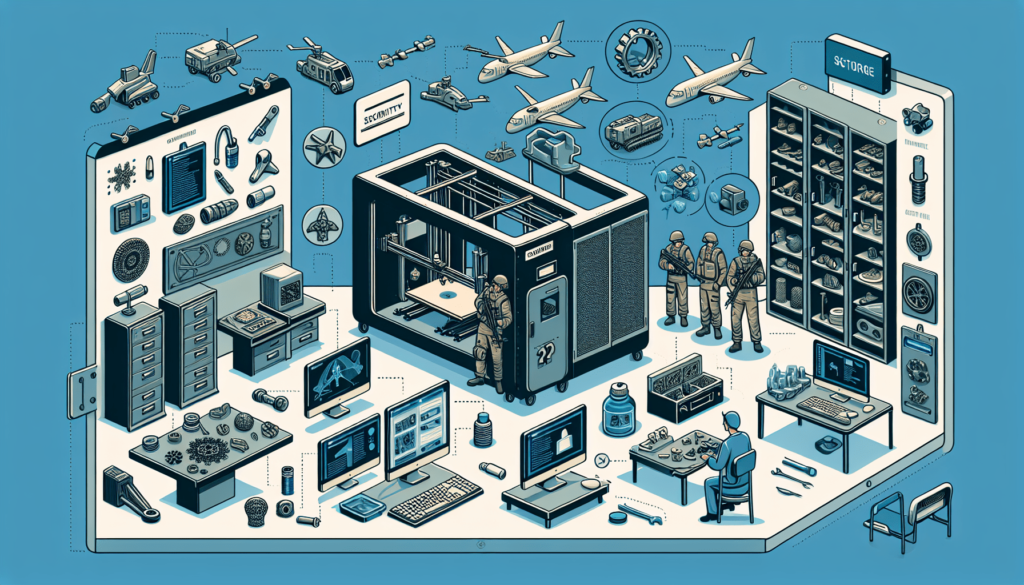
Impact of 3D Printing on Defense Industry
Disruption of traditional manufacturing techniques
The impact of 3D printing on the defense industry cannot be ignored. Traditional manufacturing techniques, such as casting, machining, and molding, are being disrupted by 3D printing. 3D printing’s ability to create complex and customized parts directly from digital designs challenges the conventional wisdom of mass production. This disruption has the potential to drastically change the way defense equipment and systems are manufactured, leading to increased flexibility and efficiency.
Transformation of supply chains
3D printing has the potential to transform the defense industry’s supply chains. By enabling on-site manufacturing and reducing reliance on external suppliers, 3D printing can streamline the supply chain and improve the responsiveness of defense procurement. This transformation can lead to more efficient and cost-effective supply chains, ensuring that military units have the necessary equipment and spare parts when and where they are needed.
Increased efficiency and faster innovation
The adoption of 3D printing in the defense industry can significantly increase efficiency and facilitate faster innovation. By eliminating the need for tooling and molds, production processes can be streamlined, reducing both costs and lead times. This increased efficiency allows for faster iteration and innovation, enabling the defense industry to respond quickly to evolving threats and operational requirements. The ability to rapidly prototype and test new concepts accelerates the development of advanced defense technologies.
Case Studies: Successful Military Applications of 3D Printing
Deployable medical solutions
The military faces unique challenges in providing medical care in remote or austere environments. 3D printing has been successfully utilized to address these challenges by enabling the production of deployable medical solutions. For example, 3D-printed medical devices, such as prosthetics or surgical instruments, can be customized and produced on-demand, providing immediate medical support to injured soldiers. This application of 3D printing has the potential to save lives and improve the quality of care in military operations.
Remote weapon systems
Remote weapon systems, such as unmanned aerial vehicles (UAVs) or ground-based robots, play an increasingly important role in modern warfare. 3D printing has been instrumental in the development and production of remote weapon systems, allowing for rapid prototyping and customization. By utilizing 3D printing, military units can quickly adapt and enhance their weapon systems, improving operational effectiveness and maintaining technological superiority on the battlefield.
Ammunition production and optimization
The production and optimization of ammunition are critical aspects of military operations. 3D printing has been successfully applied to ammunition production, allowing for customization and optimization of ammunition designs. By utilizing 3D printing, military forces can tailor ammunition to specific operational requirements, improving accuracy, efficiency, and overall combat effectiveness. This application of 3D printing has the potential to transform ammunition production and enhance military capabilities.
Future Potential and Emerging Technologies
Bioprinting for combat medicine
The future potential of 3D printing in the military extends to bioprinting for combat medicine. Bioprinting involves the use of specialized 3D printers to create complex biological structures, such as tissues and organs. In a military context, bioprinting could revolutionize combat medicine by enabling the on-site production of life-saving medical supplies, such as skin grafts or organ transplants. This emerging technology has the potential to save countless lives and significantly improve the medical capabilities of military forces.
Additive manufacturing for aerospace components
The aerospace industry is already utilizing additive manufacturing, also known as 3D printing, for the production of complex components. This technology has the potential to revolutionize aerospace manufacturing within the military, allowing for the production of lightweight, high-performance components. By utilizing 3D printing, military aircraft can be equipped with advanced components that enhance performance, reduce weight, and improve fuel efficiency. This not only increases operational capabilities but also reduces costs and maintenance requirements.
Integration with robotics and autonomous systems
3D printing has the potential to be seamlessly integrated with robotics and autonomous systems, further enhancing military capabilities. By combining these technologies, military units can produce custom robotic and autonomous systems, tailored to specific mission requirements. These systems can be designed, prototyped, and manufactured quickly and affordably, enabling quicker deployment and reducing the risk to human personnel. The integration of 3D printing with robotics and autonomous systems offers the potential for increased efficiency, improved situational awareness, and enhanced operational effectiveness.
Regulatory and Ethical Considerations
Export controls and international regulations
The proliferation of 3D printing technology raises regulatory and ethical considerations, particularly in the defense sector. Export controls and international regulations must be carefully considered to prevent the unauthorized replication of military assets or the dissemination of sensitive information. International cooperation and standardization efforts are crucial in addressing these concerns and ensuring responsible use of 3D printing technology within the military.
Ethical implications of decentralized production
Decentralized production, enabled by 3D printing, brings forth ethical implications in the military. The ability to produce equipment and weapons on-demand raises questions about accountability, transparency, and potential misuse of technology. Responsible use of 3D printing technology requires robust ethical frameworks and regulations to ensure that military assets are produced and utilized in accordance with international humanitarian law and ethical principles.
Responsible use of 3D printing technology
While 3D printing offers numerous advantages to the military, it is crucial to ensure responsible use of this technology. The military must prioritize ethical considerations, such as minimizing the environmental impacts of 3D printing, addressing issues of waste and recycling, and promoting sustainability. Additionally, responsible use includes considering the long-term implications of 3D printing on the workforce, ensuring that the technology does not lead to job displacement or inequality.
Collaborations and Partnerships in the Defense Sector
Joint ventures between defense contractors and 3D printing companies
Collaborations between defense contractors and 3D printing companies are essential for the successful implementation of 3D printing in the military. By combining the expertise of defense contractors with the advanced capabilities of 3D printing companies, innovative solutions can be developed and deployed. These joint ventures can accelerate the adoption of 3D printing in the defense sector and facilitate the integration of this technology into existing military systems and infrastructure.
Research collaborations between military institutions and universities
Research collaborations between military institutions and universities are vital for advancing the application of 3D printing in the military. By leveraging the expertise and knowledge of researchers and academics, military institutions can drive innovation and develop new technologies and processes. These collaborations can lead to breakthroughs in 3D printing materials, techniques, and applications, further enhancing the capabilities of the military.
Training and Education for 3D Printing in the Military
Developing specialized training programs
To fully utilize 3D printing technology in the military, specialized training programs must be developed. These programs should cover all aspects of 3D printing, including design and modeling, operation and maintenance of 3D printers, and quality control. By investing in comprehensive training programs, the military can ensure that personnel have the necessary skills and expertise to effectively leverage this technology and maximize its potential.
Integration of additive manufacturing into military curricula
To prepare future military personnel for the use of 3D printing technology, additive manufacturing should be integrated into military curricula. This includes incorporating 3D printing principles and practices into engineering, logistics, and supply chain management courses. By introducing 3D printing early in the educational process, the military can cultivate a workforce that is proficient in this transformative technology, ensuring its successful integration and long-term sustainability.
Conclusion
3D printing technology has the potential to transform the military in numerous ways. From prototyping and customization to on-demand manufacturing and supply chain management, the applications of 3D printing in the military are vast. Despite the challenges it presents, such as print quality and security concerns, 3D printing offers significant advantages, including enhanced operational readiness and reduced wait times. The impact of 3D printing extends beyond the military, disrupting traditional manufacturing techniques, transforming supply chains, and increasing efficiency and innovation. Successful case studies, such as deployable medical solutions and remote weapon systems, demonstrate the tangible benefits of 3D printing in the military. Looking ahead, future potential and emerging technologies, such as bioprinting and additive manufacturing for aerospace components, open up new possibilities. However, regulatory and ethical considerations must be carefully addressed to ensure responsible use of 3D printing technology. Collaborations and partnerships, both within the defense sector and between military institutions and universities, are crucial for the continued development and implementation of 3D printing. By investing in training and education, the military can equip its personnel with the necessary skills to leverage the transformative potential of 3D printing. Continued research and investment are essential as the military harnesses the power of 3D printing to enhance operational capabilities and maintain its technological edge.